Automaty · Systems for service businesses

From being found to having the work under control.

We work on one of two things: how people find you and get in touch, or how the work gets handled once it arrives. We look at what is actually happening first, then build only what is needed.

30 minutes No charge You pick the time at the end
Where to start

It is nearly always one of these two problems.

Read both and take the one that sounds like your week. You do not have to get it right — we confirm it in the conversation, and sometimes the answer is that you need neither.

01 · Presence & Acquisition

"We do good work, but we rely on someone recommending us."

How work comes in

For businesses already trading, with no way to grow beyond word of mouth.

  • They find you
  • It looks legitimate
  • They trust it
  • They get in touch
  • It can be measured
  • A presence built to be found when someone searches for what you do
  • A stranger works out in thirty seconds why you are worth calling
  • A contact path that works without you watching your phone
See Presence & Acquisition
02 · Operations & Control

"Everything goes through me and something is going to fall over."

How it gets handled after

For businesses where work comes in fine, but runs on the owner's memory.

  • A request arrives
  • It follows a process
  • It has a status
  • Someone acts
  • It leaves a record
  • A written process with states and owners, instead of remembering
  • One source of truth — not five spreadsheets and a notebook
  • Being able to delegate and take a week off without losing work
See Operations & Control

And why one company does both

Because they are two halves of the same business: how work comes in and how it gets handled afterwards. More enquiries are worth little if they get lost in a phone; a tidy back end is worth little if no new work arrives. Most people start with one, and plenty stop there.

How we work

Three steps. The same ones either way.

Understand the problem before proposing tools. We do not start from what could be built — we start from what is happening. Sometimes step one ends with almost nothing that needs building.

01 · Look

How it works today

With presence, a lot of it is visible from outside: how people find you, what a stranger sees, how they can reach you. With operations we have to come in and watch a real working day.

You get: the findings in writing, ordered by what matters most.
02 · Build

Only what is needed

What was agreed, using what you already have where it works. If your site does its job, we do not rebuild it. If your spreadsheet is enough, we tidy it rather than replace it with something nobody uses.

You get: it working, plus a plain guide to what to touch and what not to.
03 · Measure

Left instrumented

What we build is left with measurement in place and a written baseline, dated, wherever that is technically possible. The point is simple: a number exists that did not exist before.

You get: the baseline in writing, with the method used and what could not be measured.

Building is the start.

What gets handed over needs to stay standing, be looked at now and again, and improve. That conversation happens at the end of the project with real data on the table — there is no sense agreeing to a monthly arrangement over something that does not exist yet.

ImplementKeep runningMeasureImprove
Evidence

Systems already running.

See the full write-ups
Client · live Presence & Acquisition

Go Vista Projects

Before: a WordPress site that did not represent the work.
After: their own site published, with project pages and a contact path that reaches the right person.

Site · project pages · contact govista.com.au
Client · live Presence + custom system

Perrito Zen Grooming & SPA

Before: every booking taken by message, by hand, one at a time. The owner was the diary.
After: an online booking, payment and confirmation flow running in production. You can walk through it yourself.

Own site · bookings · payments perritozen.cl
Pilot · delivered Operations & Control

An accounting practice in Chile

Before: around fifteen active clients and no written process. The business ran on a spreadsheet only the owner knew how to use.
After: the critical cycles documented, and a source of truth that replaces that spreadsheet.

Review · process · source of truth See the write-up
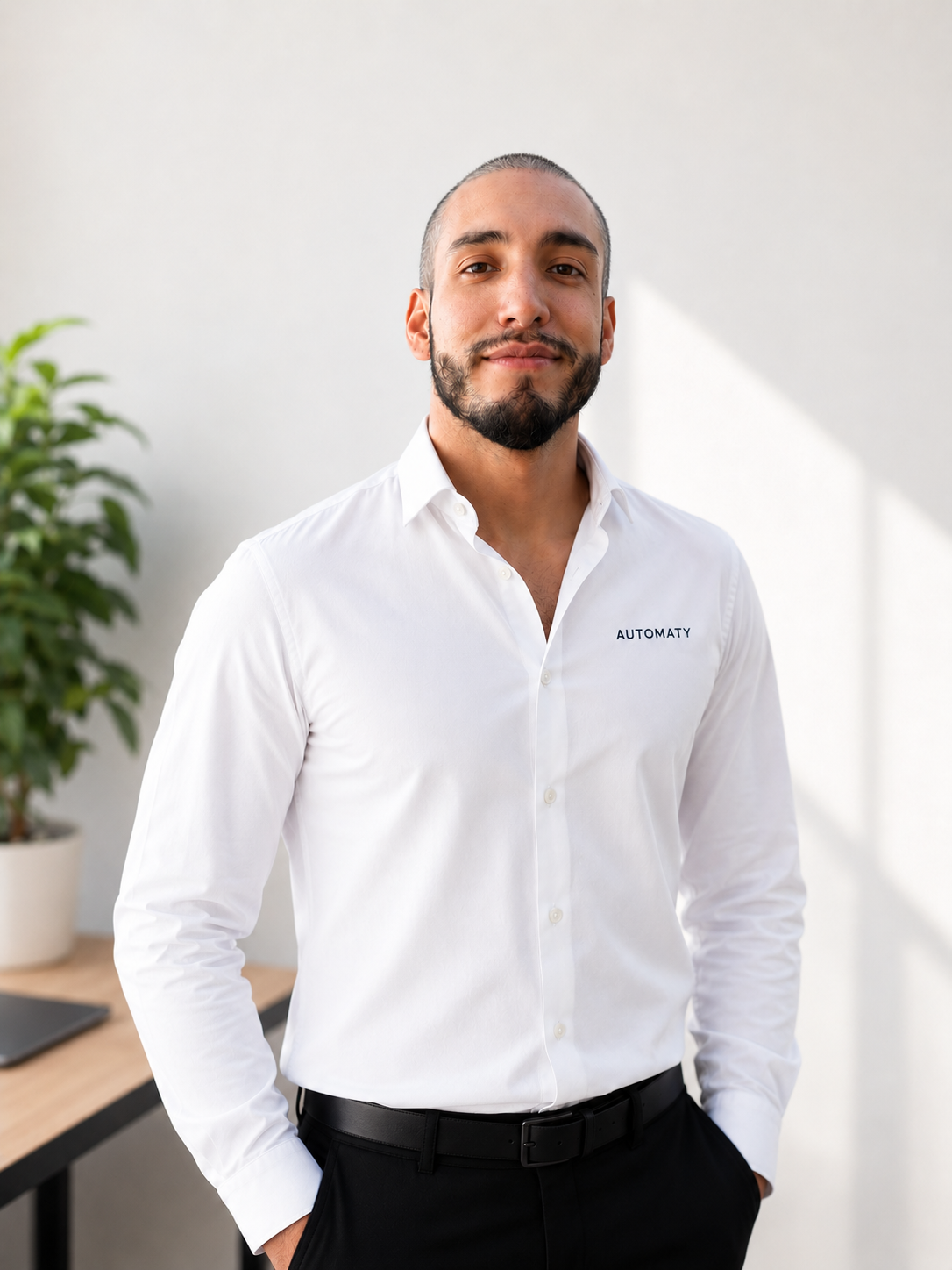
Matías Leiva, founder of Automaty

Matías Leiva — founder

Automaty is young and founder-led: the person who looks at your business is the person who builds the system. Nothing gets handed to a team that was not in the conversation.

Who is behind this
Who it fits

Not defined by industry, but by situation.

We have worked with a dog groomer, an accounting practice, a small ice manufacturer and a property developer. As industries they have nothing in common. As situations they do.

Where we are most at home: appointment-based services · local trades and services · and we are moving into small accommodation, where we have nothing delivered yet and say so before anyone has to ask.

  • The business is already trading and already has real clients. We do not work on untested ideas.
  • There is a concrete problem: either people cannot find you, or the work runs on memory.
  • The decision-maker is in the room. It is the difference between moving and posting proposals into the void.
  • Each customer is worth enough that the problem is worth fixing. On a very low ticket it does not stack up.

When we say no

When what is actually needed is paid advertising, social media management, ongoing content production, an online shop or an app. We do not sell those, we do not do them well, and we say so in the first conversation rather than halfway through a project.

What people ask before starting.

No jargon and no promises about speed.

Are you an AI or automation company?
No. We build systems: how work comes into your business and how it gets handled afterwards. Automation shows up at the end, and only once the process is clear.
Do I have to rebuild my website?
No. If the presence you already have works, we do not rebuild it to fill out a package. In that case the work goes into the contact path and into being able to measure it.
I already use a lot of tools. Will I have to change them?
Rarely. Almost no problem gets solved by switching software: it gets solved by deciding who does what, when, and on what basis. That is where we start.
What kind of businesses do you work with?
Service businesses already trading, with real clients, where the owner makes the call and there is a concrete problem: either people cannot find you, or the work runs on memory. It is not defined by industry but by the situation the business is in.
What happens in the first conversation?
Thirty minutes, no charge. You tell us how the business runs today and we leave with a clear view of which of the two problems you have, and whether we can help. It is not a deep diagnostic — it is the conversation that tells us whether one is worth doing.
What does it cost?
The first conversation is free. After that, each project is quoted on its actual scope: we do not sell fixed packages before understanding how your business runs. You get the proposal in writing before committing to anything.
Get started

Systems that give
you your time back.

Answer six questions and pick your time on the same screen. You will leave the conversation knowing which of the two problems you have — whether or not you work with us.

30 minutes · no charge No obligation Booked on the spot

Prefer to start without talking to anyone? If yours is the operations problem, the operational maturity self-assessment is twelve questions and three minutes, and it places you without us collecting anything.